Orientations
Fine Arts in the Dialogue of Cultures
Ex oriente lux - many artists of the 19th century were influenced by the light emanating from the Orient. However, the European image of the Orient that is also reflected in the fine arts was strongly shaped by stereotypes, excessive and over-romantic nostalgia for the Orient, and again re-enforced by travel reports and novels. This resulted in a range of themes that supplied the artists with motives heavily steeped in fantasy. The prologue to the exhibition ‘Orientations - The Orient and the Occident in the Fine Arts' shows how strongly these elements influenced the image of the Orient at that time. The exhibition is held in three regionale08 locations: The Kunsthalle (Art Exhibition Hall) Feldbach, the adjoining Grenzlandhalle (Borderland Hall), and the Gerber Haus (Tanners' House) in Fehring. The works of Carl Leopold Müller, Alois Schönn, Anton Romako, Leo Diet, and others are grouped together on a picture-wall.
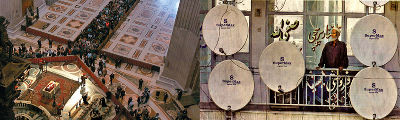
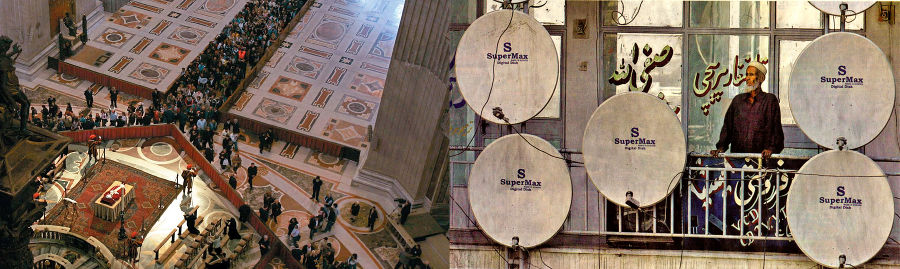
However, the majority of the exhibition is dedicated to contemporary art with works of Turkish, Bosnian, German, and Austrian artists. Selected works, media installations, and documentaries topicalise the overlap of form and content between cultural regions. The lines of separation have long become areas of transition that serve the cultural exchange. Pictures from recent journeys and every-day life document this change of function.
The exhibition has been designed with this interchange in mind. The Kuntshalle and the Grenzlandhalle are linked together in the centre, so that the exhibition can be accessed from both sides.